
0. What Sakana Fugu is
Sakana Fugu looks like a single OpenAI-compatible model, but architecturally it is a learned orchestrator. You call one endpoint; behind it, Fugu routes the query across a pool of frontier LLMs from different vendors (Gemini-3.1-Pro, Claude-Opus-4.8, GPT-5.5, and others) and returns one answer. The product promise is “frontier capability without single-vendor dependency”: because the worker pool is swappable and no provider is hardcoded into the architecture, Fugu can absorb availability and policy constraints while still reaching — and on several benchmarks exceeding — the best single model. It ships in two modes: Fugu (latency-optimized, one worker per turn) and Fugu-Ultra (quality-optimized, a planned multi-step workflow). The public SakanaAI/fugu GitHub repo is only an installer for the closed API; the method itself is documented in the Sakana Fugu technical report and two papers, TRINITY and Conductor (Sakana AI, 2026; Xu et al., 2026; Nielsen et al., 2026).
The key reframing is simple: Fugu is not a model; it is a policy over models. Sakana did not train a better frontier LLM. It trained a compact decision-maker that learns which existing LLM to ask, for what, and in what order, while the expensive language generation stays inside frozen worker models.
0.1 How the mechanism works
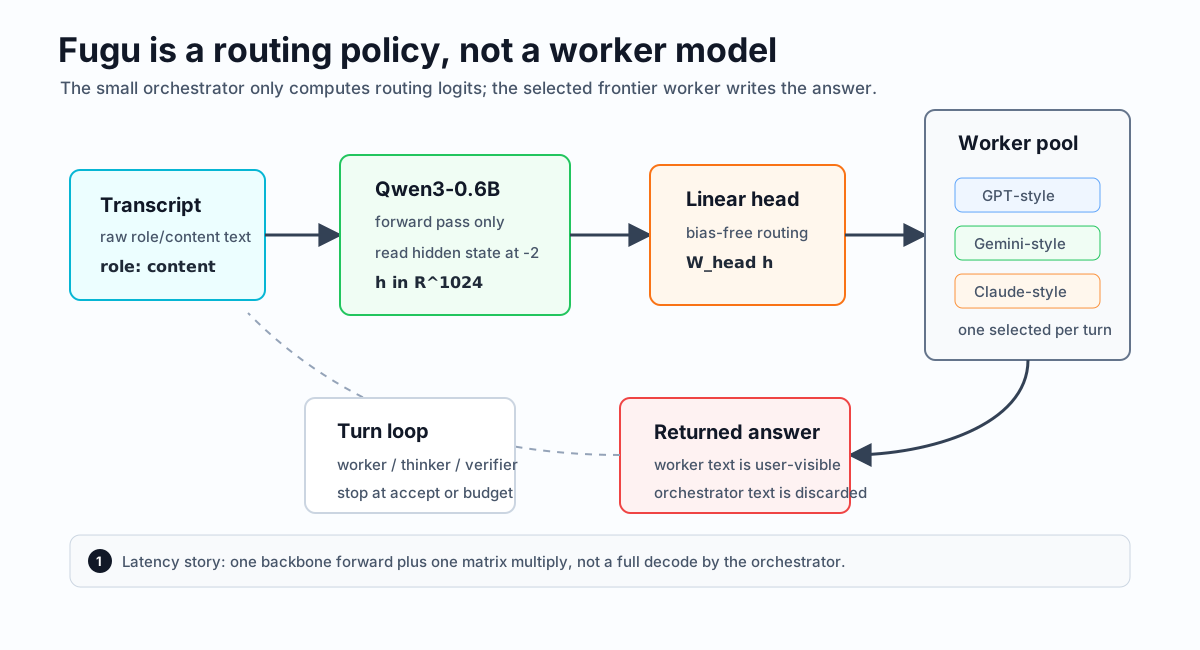
Under the product surface, the mechanism is small. Fugu runs a ~0.6B-parameter backbone (Qwen3-0.6B) that never produces the user-facing answer. For a conversation state, it computes one hidden vector and feeds that vector to a bias-free linear head that scores the worker models. The highest-scoring worker receives the query, and that worker’s reply is what the user sees. The orchestrator’s own text generation is discarded; only its routing logits matter. A routing decision therefore costs roughly one backbone forward pass plus one matrix multiply, not a full autoregressive decode. That is the latency story (Sakana AI, 2026; Xu et al., 2026).
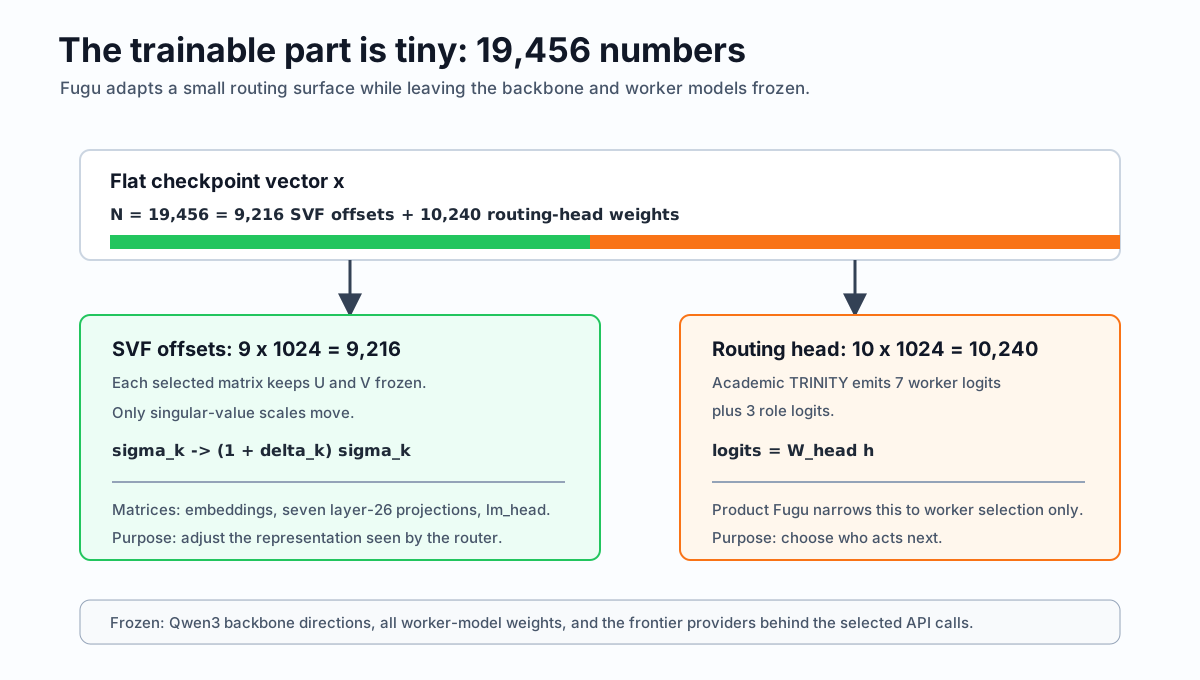
What makes it learned rather than hand-tuned is the trainable surface: the routing head plus a small set of singular-value scale offsets on the backbone, together about 19.5K trainable numbers (§2.3). These parameters are optimized so the routing logits correlate with which worker actually succeeds. Training is gradient-free — an evolutionary strategy over end-to-end task success — because the signal is sparse, expensive, and weakly coupled. Empirically, the learned routing tracks model strengths: coding-terminal work moves toward GPT-style workers, graduate science toward Gemini-style workers, and a 37-case routing fixture is reproduced at 95–100% (§6).
Fugu, the low-latency variant, stops there: read the hidden state, pick one worker, optionally assign a Thinker/Verifier role, then repeat until a verifier accepts or the turn budget is exhausted. Fugu-Ultra replaces this per-turn picker with a larger 7B “Conductor” that writes a whole workflow graph in one shot: a list of subtasks, the worker assigned to each, and the earlier outputs each worker may see. The graph is then executed with intra-workflow isolation and shared tool-call memory across the conversation (§5). In both variants, no worker weights are modified; Fugu is composition over frozen external models (Nielsen et al., 2026).
1. The core idea
§0 gave the shape. The technical bet is even narrower: the orchestrator commits to a single structural hypothesis.
the penultimate-token hidden state $h \in \mathbb{R}^d$ of a mostly frozen LM already linearly encodes which large model should act next.
If that is true, no generation, fine-tuned judge, or learned attention over candidates is needed. A single matrix multiplication, $W_{\text{head}}h$, is enough to route. The rest of the design follows from that hypothesis: a linear head (§2.1), a cheap way to adjust the backbone representation without full fine-tuning (SVF, §2.2), a ~19.5K-parameter training surface small enough for gradient-free optimization (§2.3, §3), and the per-turn or workflow loops that consume the routing decision (§4, §5). The hypothesis is also testable: on a 37-case fixture, the linear head reproduces reference routing at 95–100% (§6).
2. Fugu — parametrization
2.1 The selection policy
Variant boundary. The executable evidence below comes from the academic TRINITY checkpoint (model_iter_60.npy), whose head emits $L+3 = 10$ logits. The production Fugu described in the report drops roles and emits only $L$ logits: same backbone, narrower head. Claims about the role-emitting head are TRINITY claims; claims about role-free routing are product Fugu claims.
Let $h(s) \in \mathbb{R}^{d}$ be the backbone hidden state at the penultimate token for transcript state $s$ ($d = 1024$ for Qwen3-0.6B). A bias-free linear head $f_\theta : \mathbb{R}^d \to \mathbb{R}^{L}$ induces a categorical policy over workers:
\[\pi_\theta(i \mid s) \;=\; \frac{\exp\!\big(f_\theta(h(s))_i\big)}{\sum_{i'=1}^{L}\exp\!\big(f_\theta(h(s))_{i'}\big)}, \qquad i \in \{1,\dots,L\}.\]The head weight is $W_{\text{head}} \in \mathbb{R}^{L \times d}$ (or $\mathbb{R}^{(L+3)\times d}$ for the academic variant), so $f_\theta(h) = W_{\text{head}}\, h$. The orchestrator’s generated text is discarded. Only the logits matter, which is why $h$ can be read without running a user-facing autoregressive decode.
In the academic TRINITY variant the head emits $L+3$ logits; the last three select a role $\rho \in {\text{Worker}, \text{Thinker}, \text{Verifier}}$ from an independent softmax over those coordinates. Writing $\ell = W_{\text{head}}\, h \in \mathbb{R}^{L+3}$, agent and role are drawn (or, at eval, taken as argmax) from the two sub-vectors:
\[a \sim \mathrm{softmax}(\ell_{1:L}), \qquad \rho \sim \mathrm{softmax}(\ell_{L+1:L+3}).\]The production Fugu drops roles entirely ($L$ logits only), shrinking the coordination space to pure model selection for latency.
2.2 Singular-value fine-tuning (SVF) of the backbone
To adapt the backbone’s representation without full fine-tuning, Fugu uses SVF, following the singular-value adaptation line used in Transformer-Squared (Sun et al., 2025). For each selected weight matrix $W \in \mathbb{R}^{m \times n}$, take its singular value decomposition
\[W = U \Sigma V^\top, \qquad \Sigma = \mathrm{diag}(\sigma_1, \dots, \sigma_r), \quad r = \min(m,n),\]and freeze the orthogonal factors $U, V$, learning only a per-singular-value scale. With a trainable offset vector $\delta \in \mathbb{R}^{r}$, the adapted matrix is reconstructed as
\[\tilde\sigma_k = (1 + \delta_k)\,\sigma_k, \qquad \widetilde{W} \;=\; \big(U\, \mathrm{diag}(\tilde\sigma)\, V^\top\big)\cdot \underbrace{\frac{\sum_k \sigma_k}{\sum_k \tilde\sigma_k}}_{\text{energy preservation}}.\]The trailing scalar renormalizes total spectral energy so activation scale does not drift. $\delta = 0$ recovers $W$ exactly.
2.3 The trainable parameter vector
All learnable parameters concatenate into a single flat vector $x \in \mathbb{R}^{N}$, $N = 19456$, verified exactly from the released checkpoint:
\[x = \big[\; \underbrace{\delta^{(1)}, \dots, \delta^{(9)}}_{\text{SVF offsets, } 9216} \;\big\Vert\; \underbrace{\mathrm{vec}(W_{\text{head}})}_{\text{head, } 10240}\;\big], \qquad 9216 + 10240 = 19456.\]SVF spans 9 matrices, each contributing $r = 1024$ offsets, consumed in PyTorch state_dict order:
The head block reshapes as $W_{\text{head}} = \mathrm{reshape}(x_{9216:},\, (L{+}3,\, d)) = (10, 1024)$ for $L = 7$.
Total learnable parameters $\approx 19.5\text{K}$ — orders of magnitude below any fine-tune of the 0.6B backbone, and the reason an evolutionary strategy is tractable (§3.2).
3. Fugu — training
Training is two-stage in the product report: a supervised warm start on single-step tasks, then an evolutionary refinement on end-to-end trajectories (Sakana AI, 2026). The open academic TRINITY artifact covers the evolved-coordinator line but does not expose the product SFT stage (Xu et al., 2026).
3.1 Stage 1 — supervised fine-tuning (SFT) on single-step tasks
For each question $q$ in a verifiable dataset $\mathcal{D}$, every worker $M_i$ is run $R$ times and scored against the ground truth, giving a mean reward and a performance vector over the pool:
\[\bar r_{q,i} = \frac{1}{R}\sum_{j=1}^{R} r^{M_i}_{q,j}, \qquad s_q = (\bar r_{q,1}, \dots, \bar r_{q,L}).\]Rather than supervising on the hard $\arg\max$ worker, the scores become a soft target through a temperature softmax, preserving reward magnitudes:
\[p_q(i) = \frac{\exp(\bar r_{q,i}/\tau)}{\sum_{i'=1}^{L}\exp(\bar r_{q,i'}/\tau)}.\]Both the head and the SVF scales are trained to minimize the forward KL of the soft target $p_q$ relative to the policy (target first argument), i.e. $D_{\mathrm{KL}}(p_q \,\Vert\, \pi_\theta)$:
\[\mathcal{L}_{\text{SFT}}(\theta) = \frac{1}{|\mathcal{D}|}\sum_{q \in \mathcal{D}} D_{\mathrm{KL}}\!\big(p_q(\cdot)\,\Vert\,\pi_\theta(\cdot \mid q)\big).\]This stage places $\theta$ in a strong basin and is the only place gradients are used. The temperature $\tau$ is not disclosed. This stage exists only in production Fugu; the open TRINITY submission has no SFT stage.
3.2 Stage 2 — sep-CMA-ES on end-to-end trajectories
The second stage optimizes the expected terminal reward of the orchestrator over multi-turn agentic rollouts $\tau$ drawn from real coding-assistant environments such as Claude Code, Codex, and OpenCode. The terminal reward $R(\tau) \in {0,1}$ records whether the task completed:
\[J(\theta) := \mathbb{E}_{\tau \sim \pi_\theta}\big[R(\tau)\big].\]This objective is optimized without gradients. The parameters are weakly coupled, each evaluation is expensive because every rollout contains many LLM calls, and each terminal result is a Bernoulli draw. REINFORCE-style gradients would be extremely noisy. The paper instead uses separable CMA-ES: a CMA-ES variant whose covariance is constrained to be diagonal, $C = \mathrm{diag}(c_1^2,\dots,c_N^2)$, reducing storage and update cost from quadratic/cubic in $N$ to linear in $N$ (Ros and Hansen, 2008). In pycma, the diagonal adaptation is carried by a per-coordinate step-size vector sigma_vec rather than by a literal diagonal $C$ matrix; §7 returns to that implementation detail.
Maintaining a parent $m \in \mathbb{R}^N$, a scalar step size $\sigma$, and a per-coordinate scale $d \in \mathbb{R}^N$ (the diagonal), each iteration samples a population of $\lambda$ candidates:
\[x_i = m + \sigma\, d \odot z_i, \qquad z_i \sim \mathcal{N}(0, I), \qquad i = 1, \dots, \lambda.\]Each candidate’s fitness estimates $J$ by averaging terminal reward over $R_{\text{rep}}$ replicated rollouts, then adding the shaping terms reported in the released log. The exact normalization of the turn-count term is not exposed: \(\hat J(x_i) = \underbrace{\frac{1}{R_{\text{rep}}}\sum_{e=1}^{R_{\text{rep}}} R(\tau_e)}_{\text{mean accuracy}} \;+\; w_{\text{div}}\, H(\text{agents}) \;+\; w_{\text{turn}}\, \bar T \;-\; w_{\text{cost}}\, \bar C,\)
where $H$ is the entropy of the agent-selection distribution (diversity bonus) and $\bar T, \bar C$ are mean turn count and cost. The top-$\mu$ candidates by fitness are recombined by rank-weighted averaging to form the next parent:
\[m' = m + \sum_{k=1}^{\mu} w_k\, (x_{k:\lambda} - m) \;=\; \sum_{k=1}^{\mu} w_k\, x_{k:\lambda}, \qquad \sum_k w_k = 1,\]with $x_{k:\lambda}$ the $k$-th best candidate under the fitness ranking (the step size $\sigma$ enters only the sampling above, not this mean update).
Real configuration (from the released training log es_log.json):
With $\texttt{popsize_override}=0$, pycma defaults apply, giving the population and parent counts in closed form for $N = 19456$: \(\lambda = 4 + \lfloor 3 \ln N \rfloor = 33, \qquad \mu = \lfloor \lambda/2 \rfloor = 16, \qquad \mu_{\text{eff}} \approx 9.44,\)
with log-rank recombination weights $w_k \propto \ln(\mu + \tfrac12) - \ln k$ ($w_1 \approx 0.193$, normalized to sum 1). The paper’s “$\lambda \approx 32$” is exactly this rounding. The released checkpoint model_iter_60.npy is the $m$ at iteration 60.
The ask/tell loop itself is not in the shipped code (it lives in an un-released
experiments/with_training/module), so the structure above is reconstructed from the trainer signature, the eval-path job submission, and pycma defaults. The separable choice is load-bearing for feasibility: a full $N\times N$ covariance is intractable at $N=19456$ — but within 60 iterations even the diagonal scale $d$ barely moves; only the scalar $\sigma$ changes materially, so the run behaves like an isotropic ES (dissected in §7).
4. Fugu — the inference loop
At serving time, the orchestrator runs a bounded multi-turn loop over the transcript $\mathcal{C}$. With SVF applied to the backbone, each turn $t$:
- Format the transcript as raw
"role: content\n"text (not a chat template — proven decisive in §6), tokenize, forward pass. - Extract $h_t$ as the hidden state at position $-2$.
- Route: $\ell_t = W_{\text{head}}\, h_t$; sample/argmax agent $a_t$ and (TRINITY) role $\rho_t$.
- Inject the role’s system prompt, dispatch to worker $M_{a_t}$, append its reply to $\mathcal{C}$.
The loop terminates at the stopping time
\[\tau = \min\big\{\, t \le K : \rho_t = \text{Verifier} \;\wedge\; u_t = \texttt{ACCEPT} \,\big\}, \qquad K = 5,\]returning $O_\tau$ (the latest worker response); if no verifier accepts, it returns the last response at $t = K$. A Thinker turn may emit <suggested_role> which overrides the head’s role choice on the next turn.
5. Fugu-Ultra — the Conductor line
Fugu-Ultra replaces the per-turn selector with a 7B LM that emits an entire agentic workflow in natural language. That workflow is parsed into three equal-length lists, which together define a DAG over workers (Nielsen et al., 2026):
\[\texttt{model\_id}[1{:}T],\quad \texttt{subtasks}[1{:}T],\quad \texttt{access\_list}[1{:}T],\]Step $t$ dispatches subtasks[t] to worker model_id[t]; access_list[t] indexes which earlier outputs enter that worker’s context. The visibility relation must be topologically ordered — forward references fail — so the workflow is a DAG executed sequentially:
5.1 Training — GRPO
The Conductor is trained with GRPO on a progressive reward. The $0/0.5/1$ structure is the documented design; in code, the correctness term is supplied by an external task-specific function rather than a hardcoded constant. The GRPO form follows DeepSeekMath’s group-relative policy optimization, with the advantage normalized over grouped completions in the standard policy-gradient framing (Shao et al., 2024; Sutton et al., 1999):
\[r_i = \begin{cases} 0 & \text{lists unparseable (format fail)} \\ 0.5 & \text{parsed, executed, but wrong} \\ 1 & \text{parsed, executed, correct,} \end{cases}\]maximizing, over a group of $G$ sampled workflows per query, the clipped surrogate with group-normalized advantage and no KL penalty in production ($\beta = 0$):
\[J(\theta) = \mathbb{E}_{q,\{o_i\}\sim\pi_\theta(\cdot\mid q)} \!\left[\frac{1}{G}\sum_{i=1}^{G} \min\!\big(\rho_i A_i,\; \mathrm{clip}(\rho_i, 1{-}\epsilon, 1{+}\epsilon)\,A_i\big) - \beta\, D_{\mathrm{KL}}(\pi_\theta \Vert \pi_{\text{ref}})\right],\] \[\rho_i = \frac{\pi_\theta(o_i \mid q)}{\pi_{\theta_{\text{old}}}(o_i \mid q)}, \qquad A_i = \frac{r_i - \mathrm{mean}(r_{1:G})}{\mathrm{std}(r_{1:G})}.\]A recursion finetune lets the Conductor name itself as a worker, with a discount $\gamma = 0.2$ on the non-recursive round and per-round reward normalization.
5.2 Production-only orchestration memory
Two mechanisms, described in the report but not in the papers, make multi-agent function calling coherent:
- Intra-workflow isolation — within one workflow, agent $a$ sees agent $b$’s
trajectory only through
access_list; otherwise each keeps its own transcript. This prevents “orchestration collapse,” where the first agent’s path steers all others. - Inter-workflow shared memory — across the multi-turn conversation, agents share tool-call history, avoiding redundant re-discovery.
Formally, the context visible to agent $a$ at workflow $W$, turn $t$:
\[\text{ctx}_a(W,t) = \underbrace{\text{own-history}_a}_{\text{isolated}} \;\cup\; \underbrace{\{o_j : j \in \texttt{access\_list}\}}_{\text{topology}} \;\cup\; \underbrace{\text{tool-memory}(\,<W\,)}_{\text{shared across workflows}}.\]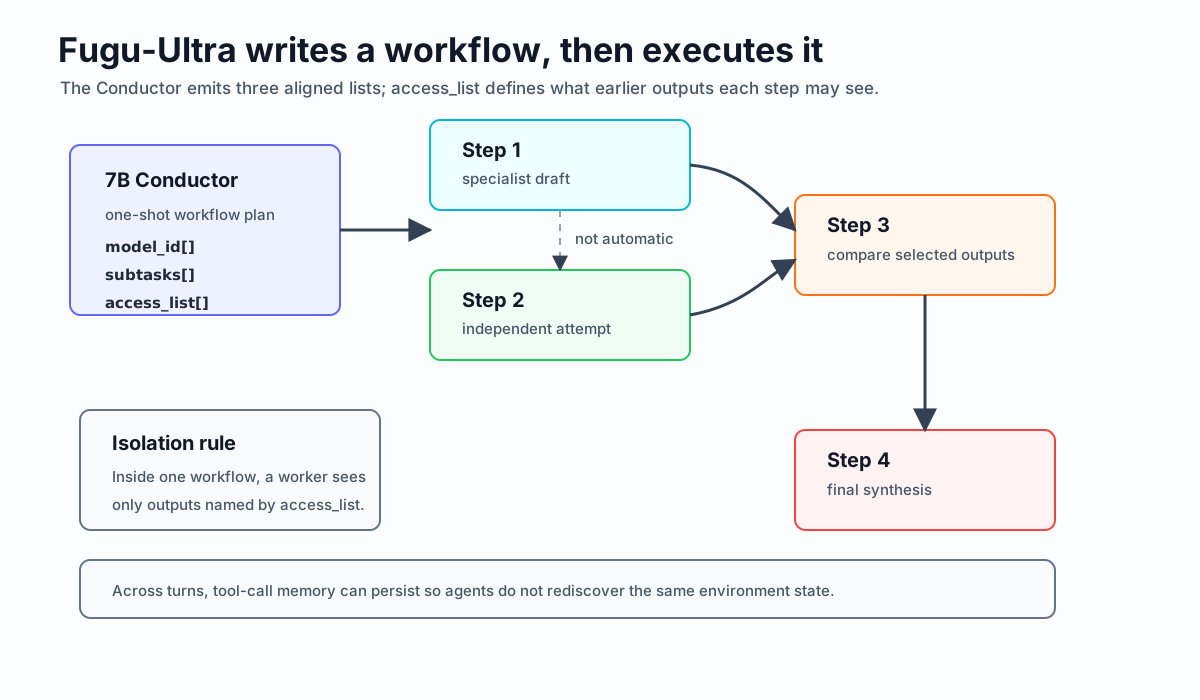
6. Execution proof
The Fugu (TRINITY) inference path was reproduced end-to-end: the released model_iter_60.npy, Qwen3-0.6B on an A800, SVF applied in state_dict order, and a 37-case fixture with expected $(a, \rho)$ labels.
| Input formatting | agent acc. | role acc. | joint |
|---|---|---|---|
| naive baseline (guess mode class) | 51% | 49% | — |
raw "role: content" |
95% | 100% | 95% |
| chat template | 41% | 11% | 5% |
Against the best constant-guess null (always picking the modal class, $p_0 = 19/37$ for agent and $18/37$ for role), a one-sided binomial test puts the agent result at $P(\ge 35/37) \approx 1.2\times10^{-8}$ and the role result at $P(=37/37) \approx 2.6\times10^{-12}$. This is not a chance fit. It simultaneously confirms the $9216 \,\Vert\, 10240$ checkpoint split and ordering, the 9-matrix SVF layout, the energy-preserving reconstruction, the raw-transcript input convention, and the pairing between checkpoint and inference path. The two agent misses are a sub-threshold logit margin ($0.214 < 0.24$, fp32 noise) and a unicode-emoji edge case.
7. What remains uncertain — stated plainly
A few pieces are not directly confirmed, and it is worth separating them from the parts above.
The most important ambiguity is what “sep” in sep-CMA-ES contributes in this run. It is not Sakana’s invention; it is the standard separable variant of Ros and Hansen, which restricts covariance to a diagonal and cuts storage/eigendecomposition cost from $O(N^2)$/$O(N^3)$ to $O(N)$ (Ros and Hansen, 2008). In pycma v4.4.4, CMA_diagonal=True does not maintain a literal diagonal $C$ matrix. It freezes the sampler’s $C$ at $I$ (GaussStandardConstant, “no update”) and moves per-coordinate adaptation into sigma_vec, so candidates are sampled as $x_i = m + \sigma\cdot\texttt{sigma_vec}\odot z_i$ with $z_i\sim\mathcal N(0,I)$. The effect is diagonal covariance, implemented outside the sampler.
At Fugu’s scale, this distinction matters. Full CMA is computationally infeasible at $N=19456$ because it would require an $N\times N$ matrix and eigendecomposition. The separable form is therefore a feasibility condition, not a cosmetic variant. But within 60 iterations, even sep-CMA’s sigma_vec barely diverges (std $\sim!6\times10^{-4}$). The only quantity that moves materially is the scalar step size $\sigma$ ($0.03\to0.002$). In practice, the run behaves like an isotropic $(\mu/\mu_w,\lambda)$-ES: scalar step-size control plus fitness-weighted mean recombination, with the diagonal machinery present but barely exercised at this budget. One correction follows from that: near-zero cross-correlation across SVF blocks is not evidence for a diagonal $C$; it is what any mode would show when covariance adaptation barely moves.
The training ask/tell loop is not in the shipped code; it lives in an unreleased experiments/with_training/ module. The reconstruction here is mostly pinned by the trainer signature, eval-path job submission, released config, and pycma defaults. The remaining details are inference rather than directly published artifact.
Everything else that remains hidden is either a credential (worker API keys, unrecoverable by design) or a tuning magnitude (the SFT temperature $\tau$, production GRPO $\beta/\epsilon$ and batch sizes, or the live worker pool and routing weights that rotate over time). Those are closed knobs, not missing architecture. The structure itself is clear: a tiny coordinator over frozen workers, an SVF-adapted backbone, a linear selection head, and evolutionary refinement on end-to-end task success.
8. One-paragraph summary
Fugu attaches a $\sim$19.5K-parameter trainable surface to a frozen Qwen3-0.6B: a bias-free linear head $W_{\text{head}} \in \mathbb{R}^{(L+3)\times d}$ plus SVF singular-value offsets on 9 backbone matrices. The penultimate-token hidden state is mapped to worker (and, in TRINITY, role) logits; the selected frontier LLM does the actual work, and the orchestrator never decodes user-facing text. Production Fugu is warm-started by KL-matching a temperature-softmax of measured per-worker rewards, then refined by separable CMA-ES directly on end-to-end task success $J(\theta)=\mathbb{E}_\tau[R(\tau)]$ — although at 19456-D over 60 iterations, that behaves in practice like an isotropic step-size-adapted ES. Fugu-Ultra swaps the per-turn selector for a GRPO-trained 7B Conductor that emits a full topological-DAG workflow with isolated-but-shared agent memory. No worker weights are modified. The system is macro-level composition over heterogeneous, swappable APIs.
[References]
- Sakana AI. 2026. “Sakana Fugu.” Technical report. https://sakana.ai/fugu.
- Jinglue Xu, Qi Sun, Peter Schwendeman, Stefan Nielsen, Edoardo Cetin, and Yujin Tang. 2026. “TRINITY: An Evolved LLM Coordinator.” arXiv:2512.04695. https://arxiv.org/abs/2512.04695.
- Stefan Nielsen, Edoardo Cetin, Peter Schwendeman, Qi Sun, Jinglue Xu, and Yujin Tang. 2026. “Learning to Orchestrate Agents in Natural Language with the Conductor.” arXiv:2512.04388. https://arxiv.org/abs/2512.04388.
- Qi Sun, Edoardo Cetin, and Yujin Tang. 2025. “Transformer-Squared: Self-Adaptive LLMs.” ICLR 2025. https://openreview.net/forum?id=dh4t9qmcvK.
- Raymond Ros and Nikolaus Hansen. 2008. “A Simple Modification in CMA-ES Achieving Linear Time and Space Complexity.” PPSN X. https://doi.org/10.1007/978-3-540-87700-4_30.
- Zhihong Shao, Peiyi Wang, Qihao Zhu, Runxin Xu, Junxiao Song, Xiao Bi, Haowei Zhang, Mingchuan Zhang, Y. K. Li, Y. Wu, et al. 2024. “DeepSeekMath: Pushing the Limits of Mathematical Reasoning in Open Language Models.” arXiv:2402.03300. https://arxiv.org/abs/2402.03300.
- Richard S. Sutton, David McAllester, Satinder Singh, and Yishay Mansour. 1999. “Policy Gradient Methods for Reinforcement Learning with Function Approximation.” NeurIPS 1999.